
China's fishing tackle production accounts for over 70% of the global total, having formed industry clusters centered in Weihai, Shandong (fishing rods), Ningbo/Cixi, Zhejiang (fishing reels), and Changzhou, Jiangsu (artificial lures), with a complete industrial chain spanning from raw materials such as carbon fiber and stainless steel to finished products.
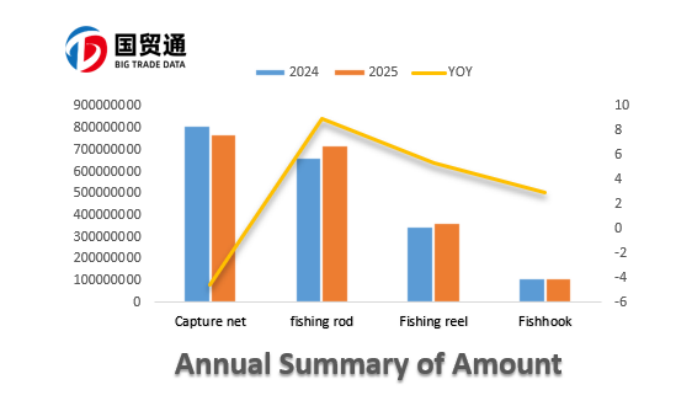
According to data from Big Trade Data, China's total export value of fishing tackle (HS: 9507) reached $1.978 billion in 2025, representing a year-on-year increase of 2.3%. Among these:
•Landing nets (HS: 95079000) : Export value of $773 million, accounting for 39.06% of total exports, down 4.59% year-on-year.
•Fishing rods (HS: 95071000) : Export value of $722 million, accounting for 36.51% of total exports, up 8.97% year-on-year.
•Fishing reels (HS: 95073000) : Export value of $368 million, accounting for 18.62% of total exports, up 5.40% year-on-year.
•Fish hooks (HS: 95072000) : Export value of $115 million, accounting for 5.81% of total exports, up 2.94% year-on-year. Overall, the market demonstrates a trend of steady expansion.
By exporting province, Shandong, Guangdong, and Zhejiang remain the primary exporting regions. Shandong firmly holds the top position, with products primarily focused on fishing rods (HS: 95071000) , which account for 56.47% of Shandong's total fishing tackle exports. Zhejiang Province mainly exports landing nets (HS: 95079000) and fishing reels (HS: 95073000) , with these two categories constituting 46.91% and 33.71% of Zhejiang's fishing tackle exports, respectively. Guangdong Province ranks second, with a more balanced product distribution compared to Shandong and Zhejiang: fishing rods (HS: 95071000) , landing nets (HS: 95079000) , and fishing reels (HS: 95073000) account for 35.06%, 31.72%, and 29.91% of Guangdong's total fishing tackle exports, respectively.
Furthermore, Xinjiang and Guangxi also warrant attention. Leveraging its geographical advantages, Xinjiang dominates the markets of Kazakhstan and Kyrgyzstan in Central Asia, serving as a crucial node on land routes. Additionally, provinces like Jiangsu, Fujian, and Anhui have achieved significant breakthroughs in countries such as the United States, Russia, and Brazil, though their overall scale and coverage still lag behind provinces like Shandong and Guangdong.
In terms of market distribution, China's fishing tackle exports now cover 150 countries and regions. Key markets include the United States, Japan, Poland, Russia, Indonesia, Kazakhstan, South Korea, Vietnam, Australia, and France. The United States serves as the dominant market, accounting for 27.41% of total export value, a scale nearly three times that of Japan, the second-largest market. The product mix for the U.S. market leans towards mid-to-high-end products.
From an overall scale perspective, the Asian market holds the largest share. While Japan and South Korea account for only 9.17% and 3.28% of export value respectively, their market average prices are relatively high, with average unit prices of $8.57 and $1.84 respectively. Countries like Indonesia and Vietnam, on the other hand, compete on volume. Furthermore, markets in India and the Philippines are also in a growth phase.
With the continued advancement of the "Belt and Road" Initiative, countries along the routes demonstrate robust market vitality. Examples include Russia, Kazakhstan, Poland, Indonesia, and Vietnam. These markets either possess geographical advantages or have large consumer populations, both harboring strong growth momentum.
As a major exporting province in China, Shandong, and specifically its city Weihai, renowned as the "Capital of China's Fishing Tackle", accounts for 34.1% of the national fishing tackle export value. Its market coverage spans multiple regions including the United States, Europe, Asia, and Australia, showcasing a trend of diversified development.
The advantages of Shandong's fishing tackle industry lie in its convenient port access, dense shipping routes, and strong industry cluster effect. Cities like Weihai, Qingdao, and Yantai are home to thousands of fishing tackle enterprises and densely distributed supporting businesses. The R&D and sampling cycle here is 30% faster than the industry average.
However, challenges coexist with opportunities. Although Shandong's fishing tackle export market is diversifying overall, the U.S. market still accounts for a high 30.74% share, reflecting a significant dependence on this market. Secondly, reliance on imported high-end carbon fiber makes the industry susceptible to fluctuations in export control policies. Simultaneously, the lack of strong brand presence means Original Equipment Manufacturer (OEM) products constitute the majority of business, resulting in weak international pricing power for independent brands.
Looking ahead, while closely monitoring trade policies, efforts should be intensified in localizing layouts in emerging markets. For instance, establishing fishing tackle experience centers in Thailand and Malaysia, and developing salt-corrosion-resistant rods suitable for mangrove fishing environments.
Overall, China's fishing tackle industry needs to transition from "capacity export" to the synergistic export of "technology + brand + service." By leveraging the advantages of industry clusters, it can become a global source of innovation for the fishing tackle industry, further strengthening risk resistance capabilities and capturing higher-value segments of the value chain.
Big Trade Data, as China's first data company, provides access to import and export customs data from over 90 countries dating back to 2010. It enables precise online analysis of import and export market distribution, detailed transaction information of importing and exporting companies, specific volume-price analysis, and supply cycles, offering reliable, evidence-based data for major foreign trade enterprises and industry consulting firms.