
Onion (Allium cepa L.) is a biennial herbaceous plant belonging to the genus Allium in the Amaryllidaceae family. Native to Western Asia, it is cultivated across China and available year-round. Its cultivation history dates back to ancient Egypt, and it was later spread worldwide by Spanish colonists. Currently, it is primarily grown in temperate regions such as Italy, Mexico, Spain, and the United States. Internationally, onions are hailed as the "Queen of Vegetables" due to their high nutritional value.
China is the world's largest producer and a significant exporter of onions. Its export market is relatively concentrated, with fresh-keeping onions as the main product. While China holds distinct advantages in price and volume in international trade, it also faces multiple challenges from both internal and external factors.
According to customs data, from January to November 2025, China's total onion export value reached $380 million, a decrease of 23.15% compared to the same period last year. The total export volume was 1.154 million tons, showing a year-on-year increase of 1.87%. The overall market average price was $0.33, down by 24.53% year-on-year. The price trend exhibited a pattern of "starting high and gradually declining."
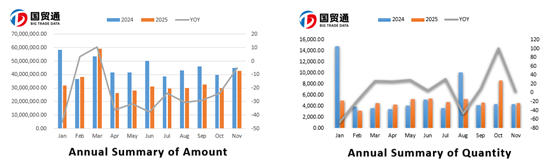
Analysis of monthly data reveals that China's overall onion export value followed an unstable, wave-like trend. Particularly in terms of export volume, the lowest point this year was in April at 68,000 tons, while the peak occurred in November, reaching 150,000 tons—a difference exceeding 80,000 tons. Overall, the second half of the year is the crucial period for exports; the cumulative export volume over the four months from August to November accounted for 44.8% of the annual total. This market volatility is directly related to the agricultural production cycle and overseas peak consumption seasons.
In terms of market distribution, China's onion exports cover over 70 markets globally. Although a diversified layout has been formed, the core markets remain relatively concentrated. The main markets include Japan, Vietnam, China Hong Kong, Malaysia, South Korea, Thailand, Russia, the Philippines, Kyrgyzstan, and Singapore.
Among them, exports to Japan account for 22.3% of the total export volume, exports to Vietnam account for 22.14%, and exports to China Hong Kong account for 12.94%. The market average prices for Malaysia and South Korea are similar, making them important large-scale export markets. Benefiting from advantages such as geographical proximity, lower transportation costs, and similar dietary cultures, these countries and regions have become the most stable and high-demand export markets. Furthermore, export volumes to Russia and Central Asian countries via land ports are also gradually increasing.
It is important to note that Chinese suppliers should actively explore markets along the "Belt and Road" initiative, such as Russia, Central Asia, and Central and Eastern Europe, to reduce dependence on any single market. Additionally, markets like Japan, South Korea, and the European Union impose extremely stringent requirements on product quality, pesticide residues, and inspection and quarantine standards. Chinese suppliers need to continuously upgrade their own standards for pesticide residue control and biosecurity management.
Overall, leveraging its strong production base, concentrated production regions, mature supply chains, and proximity to core consumer markets, China's onion exports play the role of a "stable supplier" in global onion trade. The key to future development lies in transitioning from "competing on volume" to "competing on quality and value." By enhancing product standardization, expanding into deep-processing areas, building proprietary brands, and developing diversified markets, China can effectively respond to international competition and internal fluctuations, thereby securing a more advantageous position in the global value chain.
Big Trade Data, as China's first data company, can provide import and export customs data from over 90 countries dating back to 2010. It enables online precise analysis of import/export market distribution, detailed transaction records of importing/exporting enterprises, specific volume-price analysis, supply cycles, and more. It provides reliable foundational data for major foreign trade enterprises and industry consulting firms.