
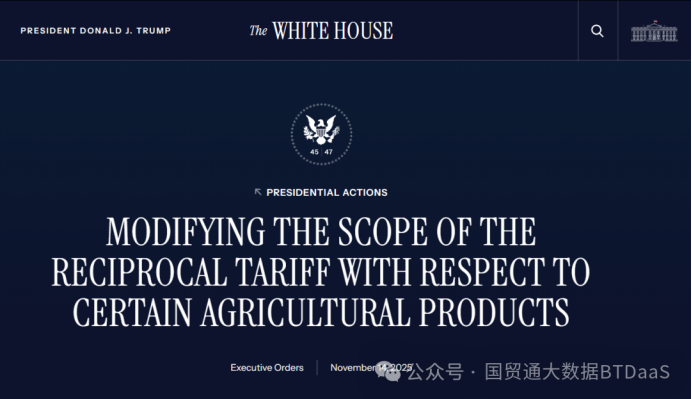
In a move to alleviate domestic inflationary pressures and optimize its trade structure, the US government recently announced two key tariff adjustments. On November 14, local time, President Trump signed an executive order eliminating "reciprocal tariffs" on 237 types of food and agricultural products. Concurrently, a statement published on the White House website confirmed a trade framework agreement with Switzerland, significantly reducing the tariff rate on Swiss imports from 39% to 15%.
I. Details on the Tariff Exemption for 237 Food and Agricultural Product Categories
This tariff adjustment, effective retroactively to 00:01 AM Eastern Time on November 13, covers eight major categories including meat, tropical fruits, and beverage raw materials, primarily focusing on imported items that are difficult to mass-produce domestically in the US. Specifics include:
Meat Products: Beef and its cuts (primarily imported from Argentina and Australia). Market prices are projected to decrease by 5-10% following the tariff removal.
Tropical Fruits and Nuts: Bananas, mangoes, avocados, pineapples, as well as almonds, cashews, etc. (main source countries: Ecuador, Guatemala). These categories constitute over 40% of the exemption list.
Beverages and Processing Raw Materials:Coffee, tea, cocoa beans, and cocoa powder (coffee mainly from Brazil and Vietnam; cocoa primarily from West Africa).
Fruits, Vegetables, and Processed Products:Citrus fruits, orange juice, tomatoes, and tomato products (mainly imported from Mexico and parts of Latin America).
Seasonings and Agro-chemical Products: Spices such as nutmeg and turmeric (main producers India and Indonesia), and agricultural fertilizers like phosphate and potash fertilizers.
It is noteworthy that alcoholic beverages (e.g., whiskey) and dominant US agricultural products like corn and soybeans were not included in this exemption. According to US Labor Department data, year-on-year price increases for beef, coffee, and tea in the US exceeded 10% this past September. This tariff adjustment is expected to effectively curb price inflation for these related goods.
II. US-Switzerland Trade Agreement Reached, Tariffs Lowered to 15%
According to the US-Switzerland joint statement, the US tariff rate on Swiss imports will drop from the current 39% to 15%. The 39% high tariff imposed on Switzerland effective August 7 this year affected nearly 60% of Swiss exports to the US, covering core categories such as watches, pharmaceuticals, chocolate, and cosmetics. Swissmem, the Swiss mechanical and electrical engineering industries association, pointed out that although this reduction alleviates the disadvantage for Swiss producers compared to competitors from the EU or Japan, trade environment uncertainties remain.
Policy Impact Analysis:
1. US importers are expected to prioritize expanding procurement of essential goods like tropical fruits, coffee, and beef, creating order windows for suppliers in Latin America, West Africa, and Southeast Asia.
2. Pressure on Swiss high-end manufacturing exports (particularly watches and precision machinery) is temporarily eased, but businesses should still monitor subsequent bilateral negotiations.
3. Collectively, these two policies signal the US's use of tariff tools to balance domestic inflation and international trade relations. It is recommended that foreign trade enterprises review potential opportunities referencing relevant HS codes (e.g., Chapters 02, 07, 08, 09, 18, 20).