
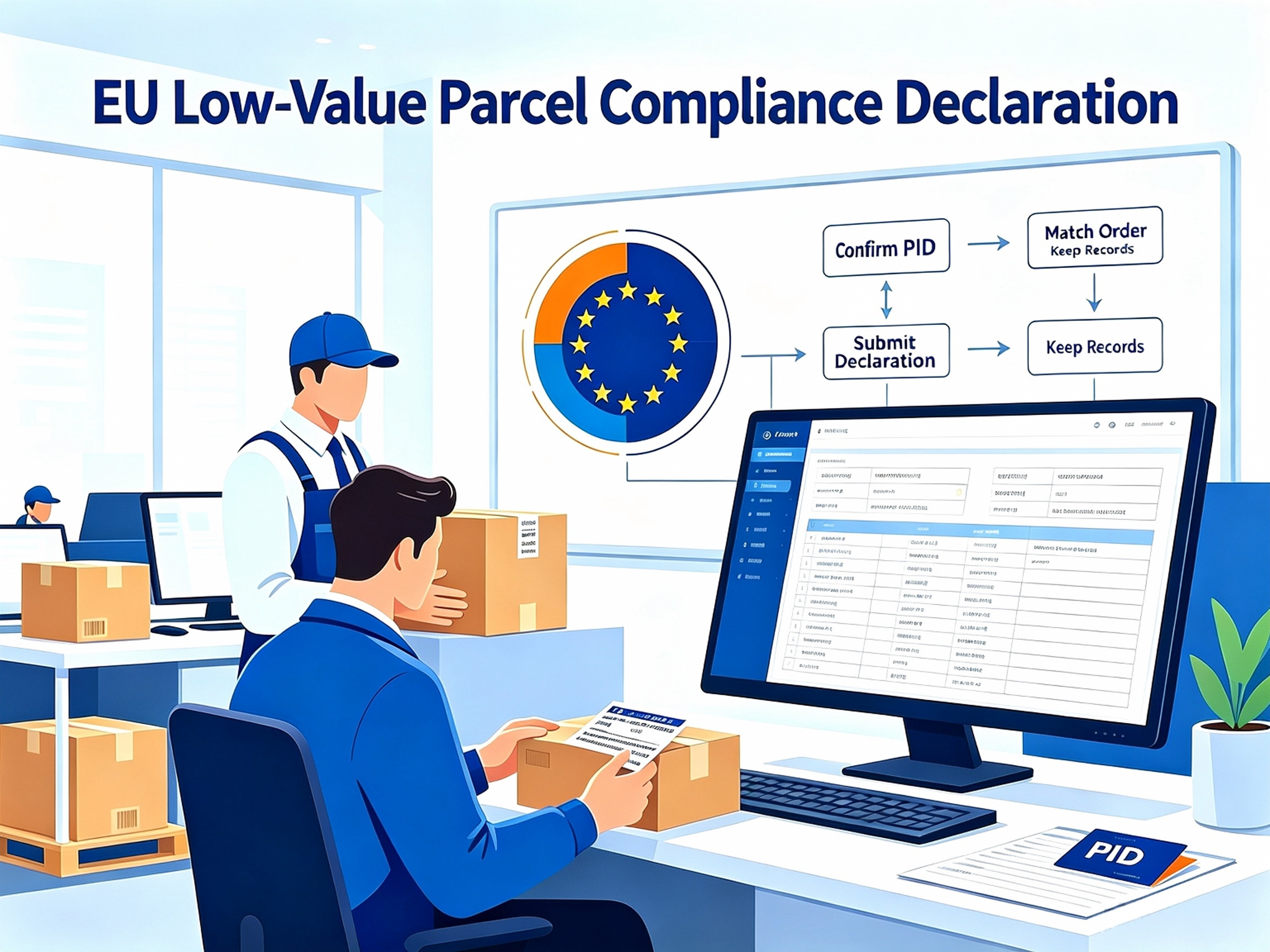
 As peak-season sales on European marketplaces reach their climax, EU customs' regulatory net is tightening in tandem. Following the abolition of the tariff exemption for sub-€150 parcels and the introduction of a €3 temporary tariff in July 2026, another critical compliance deadline is fast approaching: Starting November 1, 2026, all B2C goods sent from outside the EU to EU consumers with an intrinsic value not exceeding €150 must provide a Product Identifier (PID) at the item level during the declaration process.
This means the regulatory logic for low-value direct-mail parcels is shifting from "random inspection" to "data tracking." For cross-border sellers relying on direct-mail small parcels, time is running short to debug systems and complete product information.
I. What is a PID and Why is This a "Hard Threshold"?
A PID (Product Identifier) is a unique code used to identify a specific model, batch, or product. With the PID, customs can match a product link on a platform and a seller's inventory system to the exact physical item being imported.
According to the guidelines issued by the European Commission, starting November 1, 2026, the PID requirement applies to B2C distance sales of goods dispatched from outside the EU to EU consumers, where the intrinsic value of a single item does not exceed €150. B2B imports are not within the scope of mandatory declaration.
A PID is not a single code but is divided into three categories:
•M-PID (Merchant Product Identifier): A code assigned by an online seller, marketplace, or platform, used for the merchant's own inventory management systems. This is the mandatory required field, typically corresponding to the product link ID on the platform or the merchant's internal SKU.
• NS-PID (Non-Standardized Manufacturer Identifier): A code issued by the manufacturer or supplier that is not based on internationally recognized standards, such as manufacturer model numbers or part numbers. It must be provided if it exists.
•S-PID (Standardized Manufacturer Identifier): A code based on internationally recognized standards (such as GS1 EAN/UPC barcodes). It must be provided if it exists; if it genuinely does not exist, the corresponding code must be indicated during declaration as required.
According to the EU Q&A document, the M-PID is a mandatory data element, while the NS-PID and S-PID are "to be provided when available." If customs finds PID data missing during verification, the declaration will be deemed incomplete, and the shipment may be required to provide supplementary information, potentially leading to customs clearance delays.
II. Logistics and Platform Sides Have Synced Their Follow-up
Major logistics service providers and e-commerce platforms have entered the implementation preparation phase.
A notice issued by SF Express shows that for goods cleared after 00:00 EU local time on November 1, 2026, the new rules will be fully implemented, and the EU Handling Fee (UHF) will be charged according to the standard. Its ordering system added the PID field and launched validation in late October, requiring sellers to complete information such as M-PID and NS-PID before shipping.
Platform-side rules are also tightening. Taking TikTok Shop as an example, merchants need to fill in the merchant SKU and product identifier for each applicable product. New products with missing fields or non-compliant rules will not be able to be listed, and existing products are at risk of being delisted. Platforms such as AliExpress, SHEIN, and Temu have also successively issued announcements tightening product information management requirements.
If sellers fail to maintain PID information in time, while logistics providers may declare on their behalf, the resulting customs clearance delays, returns, penalties, and storage fees will ultimately be borne by the sellers.
III. Cost Stacking: More Than Just the PID
The PID declaration is not an isolated new requirement. It creates a stacking effect with several measures recently implemented or about to be implemented by the EU.
Starting July 1, 2026, the EU abolished the tariff exemption for low-value parcels under €150, imposing a temporary flat tariff of €3 per item category, which will last until July 1, 2028. Starting November 1, the EU Handling Fee (UHF) will also be introduced simultaneously at a standard of €2 per item, regardless of declared value, and will be stacked independently with the €3 temporary tariff.
This means that a B2C parcel with a declared value of €100 entering the EU after November 1 could face the stacked costs of a €3 temporary tariff and a €2 handling fee. For sellers with low average order values, scattered SKUs, and reliance on direct-mail small parcels, the rise in per-package costs will directly compress profit margins.
IV. Front-Loading Compliance and Re-evaluating Logistics Models
Faced with increasingly dense declaration requirements and stacked costs, cross-border sellers need to adjust at two levels.
First, treat PID information governance as a pre-shipment condition. Sellers should verify the SKU and identifier information of applicable products in their stores as soon as possible, ensuring that the M-PID accurately corresponds to the platform product link, and that the NS-PID and S-PID are completely filled in when available. Especially for sellers operating on multiple platforms, the identifier information for the same SKU needs to be aligned at once to avoid a situation where missing information on one platform prevents listing or customs clearance on that channel.
Second, recalculate the cost comparison between direct mail and overseas warehouses. When per-package taxes and handling fees stack up, and PID declarations add operational complexity, the comprehensive cost of direct-mail small parcels is converging with the overseas warehouse stocking model. Placing goods ahead of time in EU local or nearby bonded warehouses and fulfilling orders through local delivery, although requiring warehousing and inventory management costs, offers clear advantages in customs clearance certainty, peak-season timeliness, and consumer experience. For categories with low average order values and shallow SKUs, direct mail may still retain some space; however, for sellers with stable sales momentum and a long-term layout for the European market, overseas warehouses are shifting from "optional" to "essential."
With only days left until November 1, the PID is not a one-time system update but a key link in the EU's regulatory chain for low-value parcels—"making the data match." Finding a new balance among declaration information, logistics routes, and cost structures will be the core challenge for European peak-season operations going forward.