
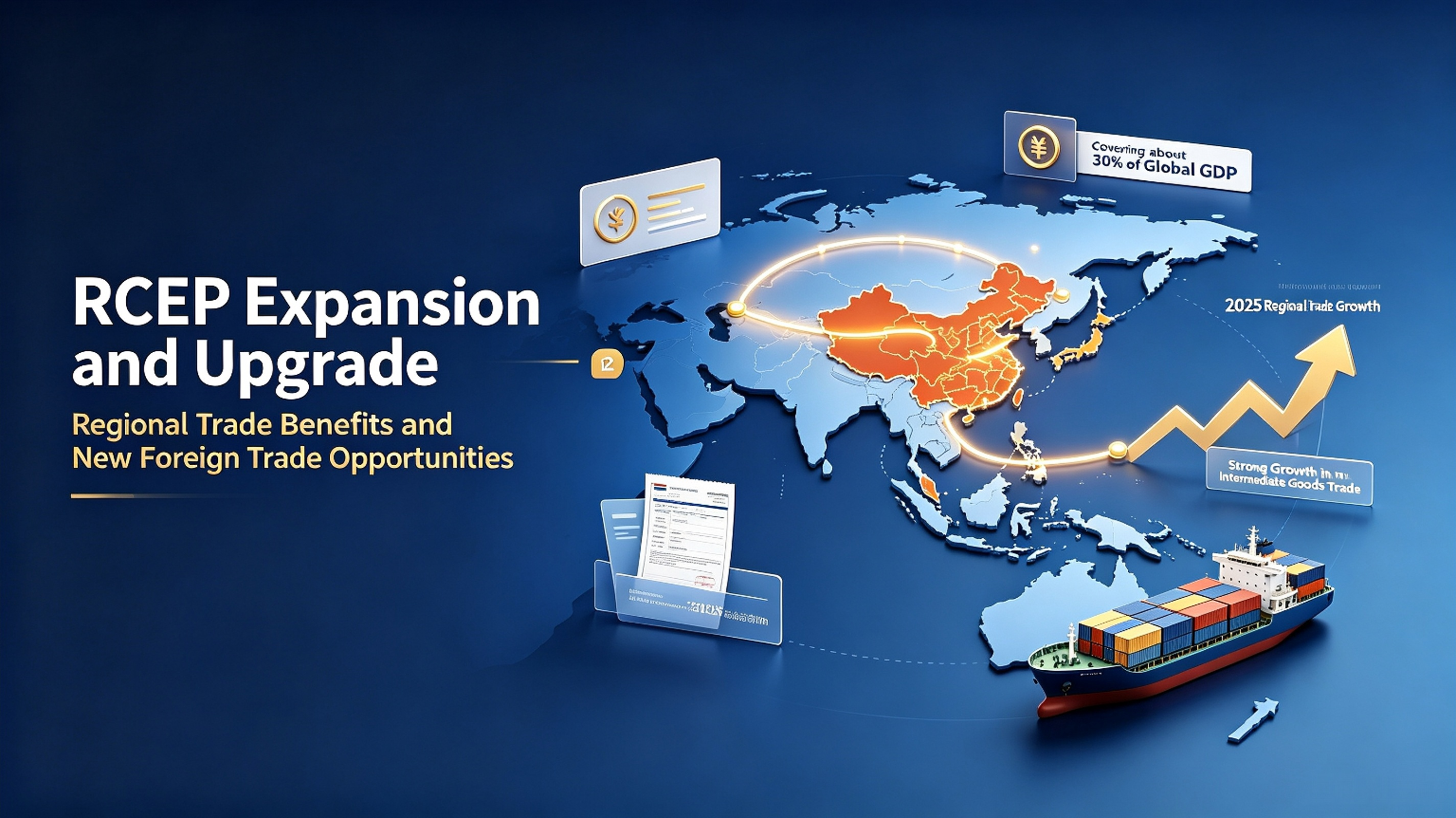
On September 21, a ministerial meeting in Manila pressed the "fast-forward" button on the Asia-Pacific free trade landscape. The fifth RCEP Ministerial Meeting after the agreement's entry into force produced two substantive outcomes: first, working groups on accession were established for Bangladesh, Chile, Hong Kong (China), and Sri Lanka, marking RCEP's expansion entering a phase of substantive advancement; second, a Joint Scoping Document for RCEP upgrading will be formulated, with the aim of announcing the launch of the upgrading process at the 2027 Ministerial Meeting. Five years after entry into force, RCEP is simultaneously opening two doors—"expansion" and "upgrading." This is not a routine follow-up meeting, but a milestone in deeper Asia-Pacific regional integration.
Core Data at a Glance
●RCEP coverage: about 30% of global GDP, population, and trade share
●Total goods imports and exports of members in 2025: over $14 trillion
●Intra-regional intermediate goods trade in 2025: $3.6 trillion, contributing 65.2% to regional trade growth
●China's goods trade with RCEP members (2025): $1.9 trillion, driving 44.4% of that year's foreign trade growth
●Share of enterprises using RCEP certificates of origin: 55.9%; 73.3% of enterprises planning to adjust supply chains chose to expand investment in China
●Digital certificates of origin: fully implemented in the ten ASEAN countries from July 2026, replacing paper certificates
First, let's be clear about why RCEP matters. As the world's largest free trade agreement by population and economic and trade scale, RCEP established common rules of origin under the existing "10+1" framework, using a single "regional cumulation rule" to weave the production processes of 15 member states into one network—as long as a product's cumulative value-added within the region reaches 40%, it can be recognized as an originating good and enjoy preferential tariffs. This rule frees "where to source more cheaply" from tariff constraints, and firmly positions China as the hub of the regional supply chain. Expansion means this network is about to be woven larger.
From "Tariff Cuts" to "Expanding Friends": The RCEP 3.0 Upgrading Roadmap Emerges
The other main thread of this meeting was "upgrading." Formulating the Joint Scoping Document for RCEP upgrading means the rules will extend from being mainly focused on goods trade to new areas such as digital trade, services trade, and supply chain integration; pushing for the 2027 Ministerial Meeting to announce the launch of the upgrading process sets a clear timetable for regional integration. At the same time, RCEP is synergizing with the China-ASEAN Free Trade Area 3.0—the latter has already advanced rule innovation in nine major areas, and the two combined will further reduce institutional costs.
The incremental space brought by expansion can already be calculated. Bangladesh's labor force and market potential, Chile's minerals and trans-Pacific connections, Sri Lanka's port hub position facing the Indian Ocean, and Hong Kong's professional services capabilities will all be injected into this cooperation network. In 2025, intra-RCEP intermediate goods trade reached $3.6 trillion, contributing 65.2% to regional trade growth, indicating that cross-border industrial collaboration is already the main growth engine—after new members join, the cumulation rule of origin will cover more supply sources, and the East Asian supply chain network is expected to extend to South Asia and Latin America.
Rule Digitalization Has Already Taken a Step Forward
From July 1, 2026, digital certificates of origin under the RCEP framework were fully implemented in the ten ASEAN countries, replacing paper certificates as an essential compliance threshold for going global; Shopee and Lazada simultaneously updated their rules, requiring that goods enjoying RCEP tariff reductions must upload valid electronic certificates.
Comparison Dimension | Traditional Paper Certificate of Origin | After Digital Certificate of Origin |
Certificate form | Paper materials, easily lost | Electronic data verified cross-border in real time |
Issuance period | 3-5 working days | As fast as within 4 hours |
Customs clearance efficiency | Slow inspection, prone to port detention | Priority release, efficiency improved by about 60% |
Platform compliance | Difficult to enjoy tariff preferences without certificate | Shopee/Lazada require mandatory upload, otherwise listing restricted |
Applicable scenarios | Mainly general trade | Full coverage of B2B and B2C |
In the past, enterprises often incurred tens of thousands of yuan in monthly port detention costs due to delayed certificates and failed paper inspections. After digitalization, customs clearance efficiency has improved by about 60%—every change in this table is a real cost calculation.
Viewed Within the National Foreign Trade Picture: RCEP Is a Key Variable for "Stabilizing Volume and Improving Quality"
Data released by the General Administration of Customs on September 8 provides a broader reference frame for the significance of RCEP. In the first eight months, China's goods trade imports and exports reached RMB 34.78 trillion, up 17.6% year-on-year; of this, trade with ASEAN was RMB 5.95 trillion, up 20.6%, and trade with Belt and Road partner countries totaled RMB 17.74 trillion, up 15.9%—market diversification continues to deepen, and dependence on any single market has noticeably declined. Nearly 80,000 foreign-invested enterprises had import and export records, and their trade growth continued to lead among all types of business entities; private enterprises' imports and exports reached RMB 19.79 trillion, up 17.6%.
An easily overlooked signal: AI-related intermediate goods trade within RCEP has reached $986.27 billion, up 15.2%, becoming a new growth point for regional trade and investment. Against the backdrop of rising external protectionism, the "clustering" effect of regional supply chains has instead strengthened—55.9% of enterprises are already using RCEP certificates of origin, and 73.3% of enterprises planning to adjust supply chains choose to maintain or expand investment in China. As the regional hub, China receives orders and intermediate goods demand from the entire network.
Foreign Trade Action List: Turn RCEP Dividends from "Policy" into "Orders"
RCEP expansion and upgrading may appear to be institutional arrangements at the regional level, but for enterprises they translate into triple opportunities in tariffs, customs clearance, and markets. The following four points are recommended for item-by-item comparison.
1.Make full use of the cumulation rule of origin: Sort out your products' HS codes and compare them with RCEP member states' tariff concession lists. As long as cumulative value-added within the region reaches 40%, you can apply for preferential tariffs—for example, a machinery part exported to Vietnam can have its tariff reduced from 8% to zero with a certificate, immediately boosting quotation competitiveness. Those who haven't calculated this are leaving profits at customs.
2.Connect with digital certificates of origin as soon as possible: The ten ASEAN countries have fully implemented electronic certificates, and Shopee and Lazada require valid certificates for goods enjoying preferences, otherwise listing is restricted. For sellers doing Southeast Asian B2C, complete enterprise qualification filing and product origin verification first; the certificate period can be compressed from 3-5 days to within 4 hours.
3.Position early in new member markets: Bangladesh, Chile, Sri Lanka, and Hong Kong (China) have established accession working groups. Bangladesh's textiles and labor, Chile's minerals and trans-Pacific channels, and Sri Lanka's port hub are all release points for the next round of demand. Enterprises with new customers or supply channels should now go through compliance and logistics links.
4.Use customs data to find increments: In the first eight months, imports and exports grew with 112 countries and regions, 17 more than the same period last year. The Big Trade Data customs platform supports multi-dimensional screening of overseas buyers by HS code, destination country, and purchase volume, helping you precisely lock in your own order base in RCEP and Belt and Road incremental markets.
RCEP expansion and upgrading may appear to be the institutional evolution of regional cooperation, but in fact they hit three key variables of foreign trade transformation: market diversification, rule digitalization, and supply chain regionalization. A report by the Chinese Academy of International Trade and Economic Cooperation points out clearly—RCEP and China-ASEAN FTA 3.0 are synergizing, and the next direction is already clear in "mutual recognition of standards, electronic documentation, cumulation of origin, and industrial chain collaboration." This means that the digital certificates of origin and cumulation rules that are being implemented today will later be replicated to more members and more product categories. Enterprises that lay out in advance will seize the next round of tariff and customs clearance dividends.