
In September 2026, global trade policies underwent another dense wave of adjustments. China and the US reached a "30 billion to 30 billion" reciprocal tariff reduction framework during their eighth round of economic and trade consultations. China-EU trade negotiations entered a critical window before the October deadline. Domestic financial regulators simultaneously introduced multiple policies to stabilise foreign trade. The policy direction of major economies is shifting from "escalating confrontation" to "seeking limited cooperation amid competition," though structural contradictions remain unresolved.
I. China-US Economic and Trade Consultations Achieve Substantive Breakthrough
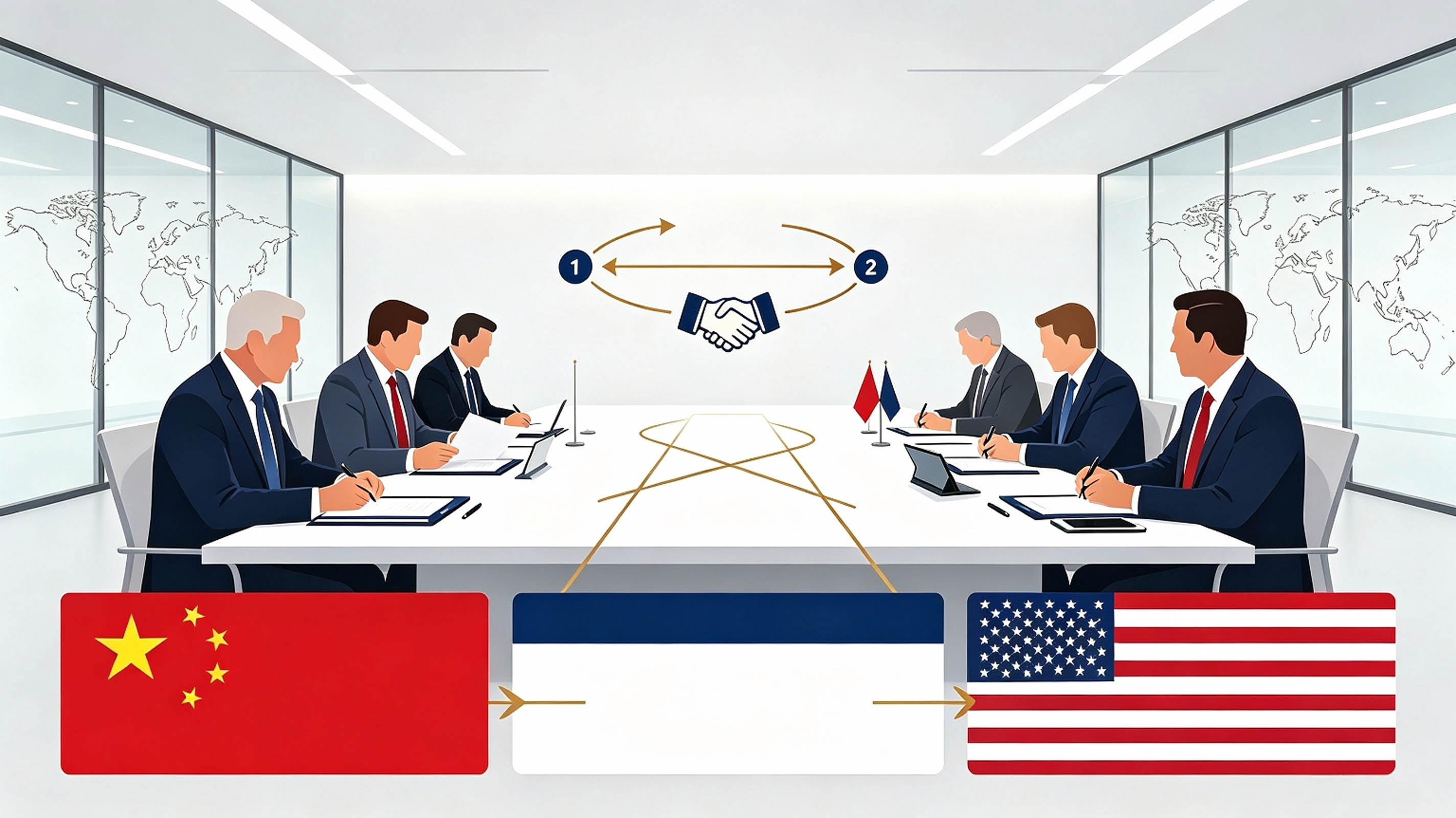
From September 20 to 23, Chinese and US economic and trade teams held their eighth round of consultations in New York and Washington, achieving positive consensus. The most core outcome of this round was that the two sides reached consensus on a $30 billion reciprocal tariff reduction framework under the Trade Council and agreed on a list of products for reciprocal tariff reductions.
According to information released by the Ministry of Commerce, the two sides agreed to provide reciprocal tariff reduction treatment to imported products worth approximately $30 billion each, on the basis of complying with their respective domestic laws and procedures. More than 90% of these products will be exempted from all mutual additional tariffs and enjoy most-favoured-nation tariff treatment. The US will reduce tariffs on approximately $30 billion of Chinese imports including toys, home appliances, baby products, kitchen and bathroom products, and holiday gifts; China will reduce tariffs on approximately $30 billion of US imports including agricultural products, personal care products, medical devices, and coal.
The background to this arrangement deserves attention. In May 2026, the Chinese and US heads of state met in Beijing and agreed to establish an intergovernmental Trade Council. During this round of consultations, the two sides also agreed to establish an Agriculture Working Group under the Trade Council to discuss related issues including regulation and market access. The Agriculture Working Group plans to hold its first meeting before the end of 2026.
It is worth noting that the focus of the US tariff reductions this time is the previously imposed additional Section 301 tariffs (mainly the Section 301 tariffs imposed in 2018, with rates between 7.5% and 25%), and the rates are expected to be reduced to the MFN base rate or even lower. However, the existing Section 301 tariffs formed during Trump's first term, the new Section 301 tariffs added in 2026, and the Section 232 tariffs on certain strategic products remain largely in place. This means that this tariff reduction is a limited "ice-breaking" move, not a comprehensive tariff loosening.
Professor Lan Qingxin of the National Academy of Opening-up at the University of International Business and Economics pointed out that the establishment of the Council mechanism means that communication has begun to shift toward institutionalisation and systematisation. "With a standing platform, a fixed agenda, and channels for tracking implementation, it is equivalent to installing a 'stabiliser' for bilateral economic and trade relations." In addition, the two sides agreed to extend the joint arrangement of the Kuala Lumpur economic and trade consultations to January 10, 2027, providing a relatively stable and predictable policy environment for business cooperation between the two sides.
There is another new highlight in this round of consultations: China and the US held their first dialogue on artificial intelligence under the economic and trade consultation mechanism and agreed to establish a communication channel for AI incidents. Analysts pointed out that AI has become deeply embedded in trade and investment links, and export controls and investment reviews may all revolve around AI. Including it in institutionalised communication means that China-US economic and trade dialogue has begun to touch more on emerging areas oriented toward the future.
II. China-EU Trade Negotiations Enter Critical Window Before the "October Deadline"
In contrast to the phased easing of China-US relations, China-EU trade relations are at a highly tense critical juncture.
On September 16, European Commission President Ursula von der Leyen delivered her annual State of the Union address to the European Parliament. Unlike 2023, when she directly announced an anti-subsidy investigation into Chinese electric vehicles, von der Leyen did not announce new trade investigations or tariff measures against China this time, but continued to hype the EU's so-called "trade deficit" with China and warned that if negotiations fail to make substantive progress, the EU will "use all available tools" to rebalance the relationship.
European Commission Trade and Economic Security Commissioner Maroš Šefčovič had previously made it clear that China needs to present a "preliminary action plan" to resolve the trade deficit before early October, otherwise the EU will take tough measures. On September 17, senior Chinese and EU trade representatives held talks to prepare for the key meeting in Beijing on October 8-9.
However, the EU is not monolithic. Spanish Minister of Economy, Trade and Business Carlos Cuerpo publicly called on September 18 for the EU to view relations with China positively and engage in "candid dialogue" with China, rather than prematurely assuming the possibility of negotiation failure. He said: "I think this is a good window of opportunity right now to see if we can seize it." Cuerpo also stressed that this is not only about trade, but also about investment, especially inbound investment from China. The EU needs to create conditions to ensure smooth technology transfer and create local jobs.
At the level of EU policy tools, the European Commission launched a new version of the EU Public Procurement Act proposal on September 9, introducing "European preference requirements," allowing public purchasers to prioritise EU suppliers and restricting foreign bidders not bound by EU international procurement commitments. In addition, the EU plans to mobilise up to €12 billion in investment through the Global Gateway programme to directly connect the South Caucasus and Central Asia to European markets, in order to diversify trade routes.
III. Domestic Financial Policies Step Up Support for Foreign Trade
While China-US and China-EU trade relations are adjusting, domestic financial regulators have also intensively introduced policy measures to support foreign trade.
On September 10, Cong Lin, Deputy Director of the National Financial Regulatory Administration, stated at a State Council Information Office press conference that efforts will be made to promote stable foreign trade, support intermediate goods exports, overseas warehouse construction, and cross-border e-commerce development. This statement is highly consistent with current changes in the foreign trade structure—exports of high-tech intermediate goods such as integrated circuits and computing power hardware are growing rapidly, and overseas warehouses and cross-border e-commerce have become important supports for new foreign trade formats.
On September 28, the People's Bank of China and seven other departments jointly issued the Guiding Opinions on Financial Support for the Expansion and Upgrading of the Service Sector, proposing measures to deepen cross-border trade and investment facilitation and encouraging service sector business entities to prioritise RMB for pricing and settlement. At the same time, it promotes the optimisation of "integrated" services such as cross-border settlement, exchange rate hedging, cross-border financing, and external guarantees, supporting enterprises to "go global" and increase their participation and influence in the international market. It is worth noting that the policy explicitly proposes to continuously improve and promote the application of the multilateral central bank digital currency bridge and the CBETS cross-border settlement comprehensive service platform, providing efficient and low-cost cross-border fund settlement services for overseas enterprises through multiple channels.
IV. Recommendations for Foreign Trade Enterprises
In the face of the current complex and volatile trade policy environment, foreign trade enterprises can respond from the following aspects:
First, seize the window of China-US tariff reductions. Categories such as toys, home appliances, baby products, kitchen and bathroom products, and holiday gifts will directly benefit from the US tariff reduction arrangement. Relevant export enterprises should closely monitor the official release of the tariff reduction product list, communicate with US buyers in advance about price adjustment space, and strive to lock in orders as soon as possible after the tariff reductions take effect. However, it should be noted that existing Section 301 tariffs and Section 232 tariffs remain largely in place, and it is not advisable to hold excessively high expectations for a comprehensive tariff loosening.
Second, closely monitor the direction of China-EU negotiations. The China-EU meeting in Beijing on October 8-9 is a key node. Enterprises involved in exports to the EU in steel, new energy vehicles, textiles, and cross-border e-commerce should assess in advance the impact of the negotiation outcome on their business and prepare contingency plans. If negotiations make progress, consider increasing investment in the European market; if negotiations break down, adjust market layout in a timely manner.
Third, make good use of financial support policies. The promotion of RMB pricing and settlement and the improvement of cross-border settlement platforms provide new tools for export enterprises to reduce exchange rate risks and settlement costs. It is recommended that enterprises proactively understand the access conditions for platforms such as CBETS and assess the feasibility of using RMB pricing and settlement, especially when trading with markets such as ASEAN and the Middle East where RMB acceptance is relatively high.
Fourth, continue to optimise the market structure. The fluctuations in China-US and China-EU trade relations once again demonstrate that excessive dependence on a single market carries systemic risks. ASEAN has maintained its position as China's largest trading partner for many consecutive years, and emerging markets in Africa and Latin America are leading in growth. It is recommended that enterprises, while stabilising traditional markets, increase efforts to develop these high-growth markets and use market diversification to hedge against policy uncertainty.
The round of policy adjustments in September 2026 shows that the global trade landscape is entering a new stage of "cooperation amid competition and competition amid cooperation." For export enterprises, closely following the policy rhythm, laying out compliance capabilities in advance, and flexibly adjusting market strategies are the keys to seizing the initiative amid changes.