
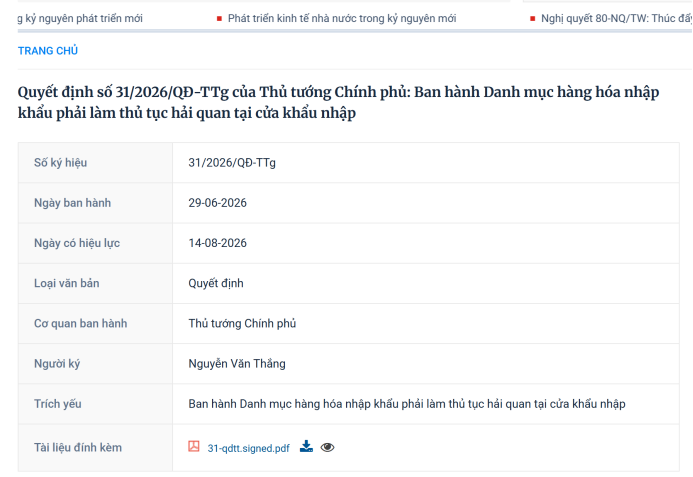
On June 29, 2026, Vietnam's Deputy Prime Minister Nguyen Van Thang signed Decision No. 31/2026/QĐ-TTg, issuing the List of Imported Goods Required to Complete Customs Procedures at the Border Gate of Entry. The decision will take effect on August 14, 2026, and simultaneously repeal Decision No. 23/2019/QĐ-TTg issued on June 27, 2019. With only one month remaining until the new rules take effect, affected importers and exporters must act swiftly to complete compliance reviews and process adjustments.
I. Core Policy Change: Clearance Model Shifts from "Inland Declaration" to "Border-Gate Clearance"
Previously, the 12 product categories covered by this regulation were permitted to be cleared at inland customs offices (such as ICDs in Hanoi, Ho Chi Minh City, and other locations) after importation. Under the new rules, this model will be completely terminated – affected goods must complete all customs declaration, inspection, and release procedures at the first port of entry, and may no longer be declared after inland transit.
In essence, the prior practice of "enter first, clear later" is now officially closed for goods on the restricted list.
II. Restricted Goods List: 12 Categories Requiring Border-Gate Clearance
According to the annex to Decision No. 31/2026/QĐ-TTg, the following 12 categories of imported goods must undergo customs procedures at the border gate:
1.Tobacco products: cigarettes, cigars, and other tobacco products for smoking, chewing, or sniffing;
2.Alcoholic beverages: spirits and other alcohol-containing beverages;
3.Malt beer: beer produced from malt;
4.Passenger vehicles: passenger cars with 16 seats or fewer;
5.High-end transport vehicles: aircraft, yachts;
6.Energy products: all types of gasoline;
7.Household air conditioners: air conditioning units with cooling capacity of 90,000 BTU or less (approximately 3 horsepower);
8.Entertainment products: playing cards;
9.Ceremonial paper products: joss paper/votive paper;
10.High-risk industrial materials: explosive precursors and industrial explosives as specified by the Ministry of Industry and Trade;
11.National defense and security materials: goods related to national defense and security as published by the government;
12.High-risk agricultural and animal products: imported goods from epidemic-affected areas or countries with significant biosafety risks, as announced by the Ministry of Agriculture and Environment.
Important note: If a single bill of lading contains both goods on the list and goods not on the list, the entire shipment must undergo customs procedures at the border gate.
III. How Is the "Border Gate of Entry" Defined? – Strict Criteria by Mode of Transport
The new regulation provides clear and strict definitions of the "first port of entry" based on different modes of transport:
Mode of Transport | Definition of Border Gate of Entry |
Sea/Air Freight | The seaport or airport where the goods are actually discharged, or the final discharge seaport/airport specified on the bill of lading (B/L) |
Rail Transport | The international railway station at the border |
Road/Inland Waterway Transport | The international border gate or major border gate through which the goods first enter Vietnamese territory (e.g., Huu Nghi, Mong Cai, etc.) |
IV. Exemptions from Border-Gate Clearance – Seven Exceptional Circumstances
Although the new policy significantly tightens restrictions, it retains the following exceptions that allow clearance at locations other than the border gate, in order to safeguard domestic manufacturing and specific economic activities:
1.Factory project equipment: machinery, equipment, and construction materials for factory construction and engineering projects;
2.Processing trade raw materials: imported raw materials for processing, domestic production, export production, or export processing;
3.Special economic zone goods: goods transported to non-tariff zones, free trade zones, or bonded warehouses;
4.Duty-free shop goods: imported goods sold in duty-free shops;
5.Emergency supplies: goods for emergency relief, national defense, security, and other special purposes;
6.Logistics support goods: containerized goods transported to domestic consolidation points (CFS) or inland clearance depots (ICDs), as well as parcels sent via postal or courier services;
7.Other special circumstances: gasoline subject to franchise regulations, or other special cases approved by the Prime Minister.
Enterprises engaged in processing trade must have a complete processing trade manual to qualify for exemptions when importing restricted goods for the production of export products.
V. Recommendations for Traders
(1) Immediately review in-transit and pending orders. Enterprises should thoroughly review recent and upcoming export orders to Vietnam and verify whether products fall under the 12 restricted categories. If products are affected, they must promptly communicate with Vietnamese customers to reassess logistics plans and clearance arrangements.
(2) Verify customer qualifications and exemption eligibility. If restricted goods are processing trade raw materials (for manufacturing export products) or factory-use equipment, customers must provide a complete processing trade manual or relevant documentation to qualify for exemption from border-gate clearance.
(3) Strictly verify documentation consistency. Border-gate clearance means inspection rates will rise significantly. Enterprises must ensure that HS codes, product descriptions, and values on the bill of lading, commercial invoice, packing list, and certificate of origin (C/O) are fully consistent. For road transport, ensure that the destination port described on the bill of lading matches the actual border gate of entry.
(4) Allow sufficient clearance time and budget for additional costs. After the new rules take effect, clearance timelines at border gates are expected to extend by 2 to 5 working days, with corresponding increases in storage fees and declaration costs. Enterprises should build sufficient delivery time buffers into contracts and negotiate cost-sharing mechanisms with customers.
(5) Monitor policy developments and establish compliance early-warning mechanisms. Southeast Asian countries are rapidly raising trade compliance thresholds, and Vietnam's new policy is a clear reflection of this trend. Exporters are advised to establish routine policy tracking mechanisms to anticipate changes and respond in a timely manner.
VI. Conclusion
With only one month remaining until the August 14, 2026 effective date, the transition window is closing fast. For affected traders, early review, rapid response, and compliant operations are the keys to avoiding disruptions. While the new rules may increase clearance costs and operational complexity in the short term, they also present an opportunity for those who complete compliance adjustments ahead of their competitors to build a competitive advantage. Rather than waiting to be affected, proactive action is the better approach – complete product reviews, customer communications, and process adjustments now, and turn regulatory change into an opportunity to optimize your supply chain management.