
The U.S. Consumer Product Safety Commission (CPSC), in collaboration with U.S. Customs and Border Protection (CBP), officially entered the mandatory enforcement phase of its electronic filing (eFiling) regulation on July 8, 2026. This marks a fundamental shift in the U.S. import compliance model for consumer products – moving from a "random inspection" approach to a "pre-clearance admission" system. All imported consumer products subject to CPSC jurisdiction must now have their certificate data submitted electronically through the ACE system prior to cargo arrival. Shipments without valid electronic data will be automatically flagged and detained by the system, with no post-arrival amendments accepted. This article provides a systematic overview of the policy changes, product scope, data requirements, and practical recommendations for exporters.
I. Core Policy Change: From "Carry-on for Random Inspection" to "Pre-arrival System Verification"
Previously, CPSC compliance certificates (CPC for children's products or GCC for general-use products) followed a "carry-with-shipment, await random customs review" model – companies presented paper certificates only when customs officials requested them during inspections.
Under the new regulation, compliance review has been moved to a "pre-arrival system clearance" stage. All certification data must be submitted electronically through the ACE system before the cargo reaches the U.S. border. The system automatically verifies the data; clearance proceeds only upon successful verification, and goods are detained if verification fails.
In short: the system has transitioned from a "random audit" framework to a "mandatory admission" framework. Without electronic filing, shipments cannot even enter the customs clearance process.
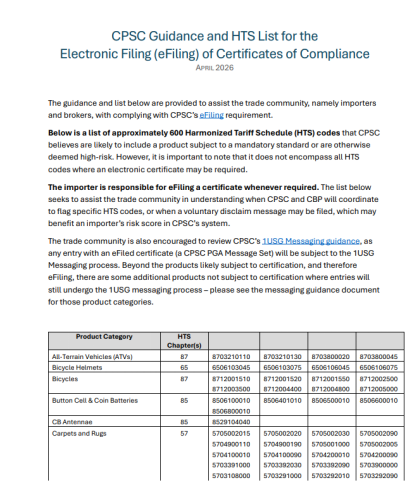
II. Scope of Application: Over 600 HTS Codes, No Exemptions
This regulation covers more than 600 HTS tariff numbers, encompassing over 15,000 types of consumer products. There are no exemptions for low-value shipments, small quantities, or samples. Regardless of shipment size or value, all consumer products subject to CPSC jurisdiction must comply with mandatory filing requirements.
Affected product categories include:
﹡Children's Products (requiring CPC certificates) : Toys, strollers, cribs, children's furniture, high chairs, walkers, children's bicycles, children's sleepwear, etc.
﹡Adult Consumer Products (requiring GCC certificates) : This applies not to all adult products, but primarily to those requiring GCC certification, including –
•Furniture & Home: furniture, clothing storage units, mattresses and bedding;
•Electronics & Appliances: consumer electronics, small household appliances (especially those
•containing button cell batteries), smart home devices, certain lighting products;
•Outdoor & Hardware: bicycles and bicycle helmets, lighters, architectural glass, magnet products, portable fuel containers, etc.
Important note: The HTS list is provided for guidance only and is not exhaustive. Even if your product's tariff number is not on the list, if the product is subject to CPSC mandatory standards, filing is still required.
Self-check tool: Exporters uncertain whether their products fall under CPSC jurisdiction can verify at the official CPSC eFiling portal: cpsc.gov/eFiling
III. Core Data Requirements: Seven Essential Items
The eFiling account must be set up and linked by the U.S. importer of record; overseas suppliers cannot file directly. As a Chinese exporter, your responsibility is to accurately compile the following seven core data items and provide them to your U.S. customer or their customs broker for system entry prior to cargo departure or arrival:
1. Product ID – The unique identifier such as GTIN, UPC, or SKU. This code must match exactly the information printed on the product packaging and labels. Any discrepancy – even a single character – will trigger a system error and hold the shipment.
2. Reference Code – The applicable CPSC safety standard or regulation citation number.
3. Date of Manufacture – The month and year the product was manufactured.
4. Place of Manufacture – The full name, complete address, and valid contact information of the manufacturer.
5. Most Recent Compliance Test Date – The specific date of the most recent compliance test conducted on the product.
6. Testing Laboratory Information – The name, address, and contact information of the laboratory that issued the test report. The lab must be a CPSC-accredited testing facility.
7. Responsible Party for Records – The name, address, and contact information of the individual or entity responsible for maintaining the test records.
Critical reminder: Errors or omissions in any of these seven data points may result in system validation failure and cargo detention. Exporters are strongly advised to organize and verify all information in advance, and ensure alignment between filing data and physical product labeling.
IV. Recommendations for Exporters
1. Immediately review whether your products fall under CPSC jurisdiction. Do not wait until shipments arrive at port to discover compliance issues. Visit cpsc.gov/eFiling now to check whether your product HTS codes are within the regulated scope and confirm your compliance obligations.
2. Promptly contact your U.S. customers to verify their eFiling account status. The eFiling account must be activated by the U.S. importer. If your customers have not yet registered, urge them to do so without delay. Do not wait until after shipments have departed to discover that they lack the necessary account access.
3. Pay close attention to data compliance details. The seven data items listed above must be complete, accurate, and consistent with actual product labels. We recommend conducting a thorough internal audit of these items well in advance of shipment.
4. Be aware of varying compliance risks across product categories. Children's products are a primary focus for CPSC enforcement, with stricter data requirements and higher inspection rates. Exporters handling toys, strollers, baby products, or similar items should maintain more rigorous compliance preparation than those shipping general adult consumer goods.
5. Use market shifts to identify new opportunities. As compliance costs rise under the new regulation, some smaller exporters may exit the U.S. market. By monitoring trade data, exporters can track whether shipments in certain categories decline significantly after July – if so, this may indicate that some competitors are not yet eFiling-compliant, potentially opening new business opportunities.
V. Conclusion
The CPSC eFiling regulation represents a long-term, permanent standard for U.S. market access – not a temporary measure. Exporters to the United States must complete product compliance reviews, confirm customer account readiness, and organize all filing data as early as possible to avoid detention at port. Compliance cannot be left to chance – the earlier you act, the lower your risk.