I. Tariff Adjustments
U.S. Imposes 25% Section 301 Tariff on Brazilian Goods
On July 15, the U.S. Trade Representative's office (USTR) officially announced the imposition of a 25% tariff on goods originating from Brazil, under Section 301 of the Trade Act of 1974. According to estimates by the National Confederation of Industry of Brazil (CNI), approximately 4,100 Brazilian export products to the U.S. will be affected. However, the USTR simultaneously published an exclusion list covering agricultural products, minerals, chemicals, pharmaceuticals, metals, wood and pulp, machinery and equipment, aircraft parts, and artworks. Additionally, the USTR is proposing another 12.5% Section 301 tariff on Brazil, which is expected to be implemented shortly.
Philippines Formally Imposes Safeguard Duty on Chinese Cement at PHP 349 per Metric Ton
Effective July 6, 2026, the Philippine Bureau of Customs (BOC), pursuant to Department of Trade and Industry (DTI) Administrative Order No. 26-03 and Customs Memorandum Order No. 164-2026, has officially imposed safeguard duties on imports of Ordinary Portland Cement and Blended Cement (HS codes 2523.29.90 and 2523.90.00) originating from China and Indonesia. The duty rate is set at PHP 14 per 40 kg (approximately PHP 349 per metric ton). Both countries were removed from the developing-country exemption list because their import shares exceeded the 3% threshold in 2025 and the first quarter of 2026. The Electronic to Mobile (E2M) system has been updated accordingly.
Section 301 Tariffs Seamlessly Expanded: U.S. Imposes 10%-12.5% New Tariffs on 60 Economies
On July 23, the USTR released a new Section 301 tariff list, imposing tariffs on 60 trading partners in connection with forced labor concerns. The list ranges from China, the EU, Japan, and South Korea to India, Brazil, Vietnam, and Saudi Arabia. The new tariffs took effect on July 24, 2026 (U.S. Eastern Time), with rates set at two tiers: 10% and 12.5%. China has been placed in the 12.5% tier.
II. Policy and Regulatory Updates
China's Ministry of Commerce Adds 14 EU Entities to Export Control List
On July 24, China's Ministry of Commerce issued Announcement No. 30 of 2026, adding 14 EU entities, including Lafert S.p.A., to its export control list. Exporters are prohibited from supplying dual-use items to these entities. Overseas organizations and individuals are also prohibited from transferring or supplying dual-use items originating from China to these entities. Any ongoing activities must be halted immediately.
Joint Announcement by China's Ministry of Commerce and General Administration of Customs: Temporary Ban on Helium Exports
On July 10, China's Ministry of Commerce and the General Administration of Customs issued a joint announcement imposing a temporary ban on the export of helium (HS code 2804290010). The ban took effect immediately on the date of announcement (July 10). Further adjustments will be announced separately.
Three Chinese Ministries: Battery Consumption Tax Policy to Be Adjusted in Phases Starting September 1
The Ministry of Finance, the General Administration of Customs, and the State Taxation Administration recently issued an announcement on adjusting the consumption tax policy for certain battery products, effective September 1, 2026. This marks the first major policy shift in 11 years since batteries were brought under the consumption tax framework in 2015.
China–Uzbekistan AEO Mutual Recognition Effective August 1!
The General Administration of Customs of China has announced that the "Authorized Economic Operator (AEO) Mutual Recognition Arrangement" between the General Administration of Customs of the People's Republic of China and the Customs Committee of the Ministry of Economy and Finance of the Republic of Uzbekistan will officially take effect on August 1, 2026.
Three-Ministry Announcement Takes Effect: Major Changes to Germplasm Export Customs Procedures
On July 14, 2026, China's Ministry of Agriculture and Rural Affairs, the National Forestry and Grassland Administration, and the General Administration of Customs jointly issued Announcement No. 1031. A new digital framework governing the approval and customs clearance of crop and forest germplasm exports will be implemented starting August 1, 2026.
Vietnam to Simplify Goods Classification Procedures Starting September 15
Effective September 15, 2026, Vietnam's Circular No. 85/2026/TT-BTC will replace Circulars No. 14/2015 and No. 17/2021, restructuring the legal framework for goods classification. The new regulation emphasizes IT application and data sharing, reduces paper documentation, and shortens customs processing times. It also clarifies that analysis results will no longer be used for quality or food safety inspections, and allows direct reference to standards issued by competent authorities for HS code determination, significantly reducing compliance costs. For Chapters 84, 85, and 90 machinery, registration of deduction tracking slips is no longer required; only a pre-clearance catalogue registration is needed. Sampling now requires only one party to be present.
Vietnam Mandates Port-of-Entry Declaration for 12 Imported Product Categories Starting August 14
Vietnam has issued Decision No. 31/2026/QĐ-TTg introducing major changes to customs management for imported goods. The new regulation explicitly requires that 12 categories of imported goods — including tobacco, alcoholic beverages, passenger cars (16 seats or fewer), household air conditioners (≤ 90,000 BTU), gasoline, and playing cards — must be declared and inspected at the port of entry rather than at the importer's registered address, effective August 14, 2026. Household air conditioners, a common cross-border e-commerce category, are expected to face extended port detention and inspection lead times of 2–5 additional working days, along with increased warehousing and manual declaration fees. Only plant construction equipment, production raw materials, bonded-zone goods, and emergency supplies are exempt from this requirement.
Indonesia to Fully Implement Strategic Commodity Single Export Control System on September 1
Indonesia's President has announced the full implementation of the Strategic Commodity Single Export Control policy on September 1, covering dozens of categories including palm oil, rubber, timber, and mineral products. Exporters must complete electronic declarations, origin verification, and foreign exchange settlement registration before loading. Cargo that has not been approved cannot be cleared. The policy aims to curb under-invoicing and arbitrage in exports.
New U.S. Consumer Product Safety Declaration Rules Take Effect
On July 8, 2026, the U.S. Consumer Product Safety Commission (CPSC) implemented new customs declaration rules for imported consumer products to strengthen safety oversight. On the same day, U.S. Customs and Border Protection (CBP) issued Notice No. 41f915e, launching the PGA Message Set eFiling system compatible with the CPSC rules. The new regulations cover a wide range of products, including children’s products, textiles and apparel, electronics, household goods, furniture, kitchenware, toys, cosmetics, sporting goods, and lithium batteries.
New USPS Rule: Hazardous Materials Handling Fee Effective July 12
Effective July 12, the U.S. Postal Service (USPS) will impose a $7.50 handling fee on hazardous materials parcels, including essential oils, nail polish, and electronics containing lithium batteries. Non-compliant declarations will incur a $50 penalty. Additionally, the new rule adjusts the dimensional weight factor from 166 to 139 and eliminates ounce-based pricing differences for Commercial Ground Advantage services. Sellers are reminded to ensure compliance to avoid extra costs. A further holiday-season rate increase is expected this October.
EU Exempts 6 Categories of Small Devices from Mandatory Removable Battery Requirement
On July 14, 2026, the European Commission announced a revision to the "Portable Battery Removability Rules," exempting six categories of small electronic devices — including smartwatches, fitness trackers, and electric toys — from the mandatory removable battery requirement. The exemption aims to mitigate safety risks and technical infeasibility associated with removal. The new regulation will be submitted to the European Parliament and Council for review and will take effect 20 days after publication in the Official Journal, barring objections. The EU emphasized that this adjustment was based on broad consultations with consumer organizations, industry representatives, and member states, and is not a concession to external pressure.
EU New Packaging Regulation (PPWR) Takes Effect in August
As of August 12, 2026, the EU's new Packaging and Packaging Waste Regulation (PPWR) will be uniformly enforced across all 27 member states. PPWR fully replaces the previous Packaging and Packaging Waste Directive (94/62/EC). Unlike the directive, PPWR is legally binding in its entirety for all member states, ensuring uniform packaging rules and promoting reduction, recyclability, non-toxicity, and sustainability throughout the packaging lifecycle.
Russian Customs Requires Submission of Reports on Conditionally Released Goods by July 31, 2026
The Federal Customs Service of Russia has reminded foreign trade participants to submit reports on conditionally released goods. The relevant data must be submitted by July 31, 2026, covering goods that remained in this status as of June 30 of the current year. Declarants are required to submit reports by January 31 and July 31 each year for goods still under conditional release as of December 31 and June 30, respectively, except for goods that have obtained EAEU product certification. Reports must be submitted via a dedicated service in the foreign trade participant’s personal account. Customs authorities warn that late submissions or provision of false information will result in liability under Article 16.15 of the Russian Code of Administrative Offenses. This requirement is based on Customs Order No. 2002 dated December 10, 2018 (as amended November 19, 2024).
Israel Issues Mandatory Standard for Plugs and Sockets, Effective August 8
Israel's Ministry of Economy has published the third amendment to Mandatory Standard SI 32 Part 1.1 in Official Gazette No. 12252, covering safety requirements for plugs and sockets for single-phase circuits up to 16A. The new standard will take effect on August 8, 2026.
Kenya KRA ACD New Rules Fully Implemented Starting August 3
The Kenya Revenue Authority (KRA) has announced the full implementation of the Advance Cargo Declaration (ACD) system for containerized cargo, effective August 3, 2026. All containerized cargo destined for Kenya must complete ACD declaration and obtain a reference number before loading. This reference number must be indicated on the bill of lading prior to shipment.
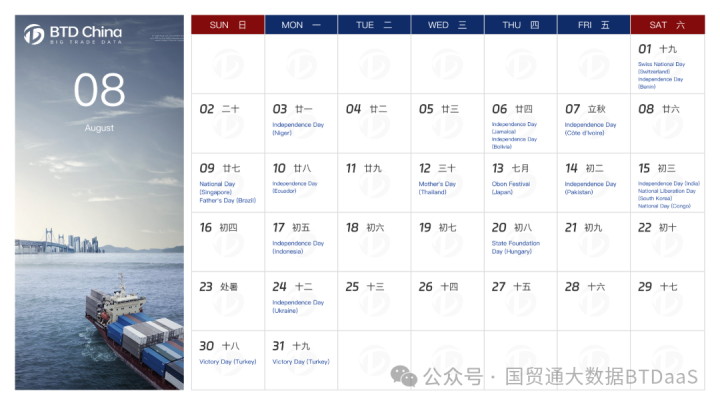
August 2026 Foreign Trade Marketing Calendar
Stay tuned for key international trade events and holidays in August. Plan your marketing campaigns accordingly to maximize reach and engagement.