
A wireless router is a wireless coverage device that integrates the functions of a wireless access point (AP) and a broadband router. It primarily converts wired network signals into wireless signals through antennas, allowing devices such as mobile phones and computers to access the internet.
Mainstream wireless routers on the market typically support four access methods: dedicated xDSL/Cable, dynamic xDSL, and PPTP. They generally support simultaneous online use of only 15 to 20 devices. These devices also feature network management functions such as DHCP service, NAT firewall, MAC address filtering, and dynamic domain name service (DDNS).
Common wireless routers are usually equipped with one RJ45 interface as the WAN port (the uplink interface to the external network), and the remaining two to four interfaces are LAN ports (used to connect to a local area network). An internal network switch chip is integrated to handle information exchange between LAN ports. The routing working mode between the WAN port and LAN ports of a wireless router typically uses NAT (Network Address Translation).
The signal coverage radius of ordinary wireless routers is typically 50 meters, though some products have already achieved a coverage radius of up to 300 meters. With technological advancements, wireless router products supporting the Wi-Fi 7 standard have entered the market, and international demand for such products is continuously growing.
According to data from Big Trade Data, China's wireless router (HS code: 85176295) export scale saw steady growth in the first quarter of 2026. The total export value for the first quarter reached $539 million, with a total export volume of 16.03 million units and an average unit price of $33.6 per unit.
Looking at the monthly trend, exports in the first quarter rose steadily month by month. In January, export value was $155 million. In February, driven by concentrated order deliveries after the Spring Festival, it increased to $191 million, a month-on-month increase of 23.7%. In March, it further increased to $193 million, a slight month-on-month increase of 0.6%. In terms of export volume, the figures for January to March were 4.33 million units, 5.75 million units, and 5.95 million units respectively, maintaining synchronized growth. It is worth noting that the product unit price declined slightly month by month, from $35.69 per unit in January to $32.48 per unit in March, a decrease of about 9%, which may be related to an increasing share of lower-priced products.
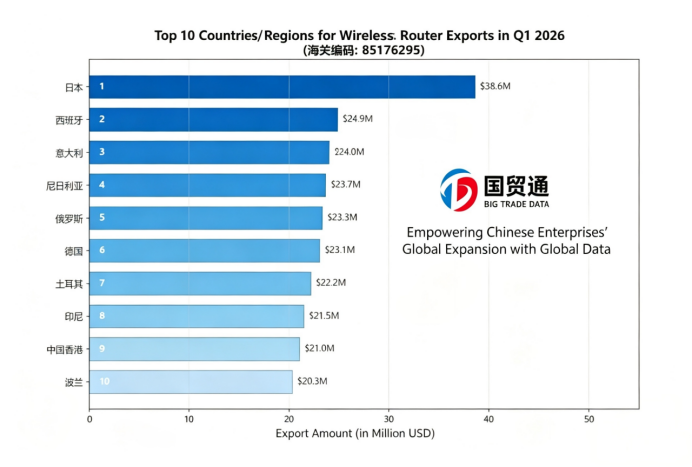
From a market distribution perspective, China's wireless router (HS: 85176295) export destinations in the first quarter were relatively scattered, with the top ten markets collectively accounting for about 40.1%, reflecting a relatively balanced export market distribution. Japan ranked first with an export value of $38.6 million, accounting for 7.16%. Spain and Italy ranked second and third, with shares of 4.61% and 4.45% respectively. Notably, the Russian market performed prominently, with export value reaching $23.3 million, ranking fifth with a share of 4.32%, and it was also the second-largest market in terms of export volume. Turkey ranked first in export volume with 9.95 million units, accounting for 6.21%.
As global network infrastructure construction continues to advance, demand for wireless routers in overseas markets is expected to maintain a growth trend. This is mainly driven by four factors: First, the acceleration of network penetration in emerging markets – broadband coverage rates in Southeast Asia, Africa, and Latin America continue to rise, driving import demand for consumer-grade network equipment. Export performance to markets such as Nigeria and Indonesia in the first quarter confirms this trend. Second, product upgrade and replacement demand – the rapid adoption of Wi-Fi 6/7 technology is driving households and enterprises to upgrade their routers. An increasing share of high-end products will help lift the overall export unit price. Third, the expansion of cross-border e-commerce channels – platforms such as Amazon, AliExpress, and Temu are becoming increasingly mature, lowering export barriers. This not only opens up overseas retail markets for small and medium-sized enterprises but also facilitates Chinese brands to directly connect with overseas consumers. Fourth, the significant potential of the Russian-speaking market – the Russian market performed well in the first quarter. As its demand for digital product import substitution continues to be released, the Russian-speaking market is expected to become a new growth point.
However, while seizing market opportunities, Chinese export enterprises also need to guard against the following risks:
1. Market concentration risk: The top ten export destinations account for only 40%, indicating a relatively fragmented market. While this helps diversify risks, it also means enterprises need to invest more resources in multi-market operations. It is recommended that enterprises select key markets to focus on based on their own strengths.
2.Downward pressure on unit price: The product unit price fell from $35.69 to $32.48 in the first quarter. Enterprises should be vigilant about the squeeze on profit margins caused by low-price competition. It is recommended to enhance pricing power through product differentiation and improved after-sales services.
3.Compliance requirements in target markets: Radio equipment certification standards vary by country, such as Japan's TELEC certification, the EU's CE certification, and Russia's EAC certification. Before exporting, enterprises should ensure that products meet local technical standards to avoid customs clearance delays.
4.Exchange rate risk management: Two-way fluctuations of the RMB exchange rate have become the norm. It is advisable to flexibly use tools such as forward settlement and options to lock in costs, and consider including exchange rate adjustment clauses in contracts.
5.Supply chain stability: There remains uncertainty in the supply of core components such as chips. Enterprises need to strengthen cooperation with suppliers, maintain reasonable safety stock levels, and closely monitor price fluctuations of upstream raw materials.
6.Brand building: In terms of export unit price, Japan leads with $62.42 per unit, indicating strong demand for high-end products in that market. It is recommended to build brand image through improved product quality and gradually move up the value chain toward the mid-to-high end.
Note: HS code 85176295 is a new code introduced in 2026, and no comparable historical data is available for this reporting period. The analysis conclusions are based solely on single-period data from the first quarter of 2026, and subsequent tracking will be needed to support trend judgments.
Big Trade Data, as the first data company in China, provides import and export customs data for over 90 countries from 2010 to the present. It enables online precision analysis of import and export market distribution, detailed transaction information of import and export enterprises, specific volume-price analysis, supply cycles, and more. It provides reliable data-driven insights for foreign trade enterprises and industry consulting firms.