
Invented by Philippe-Guy Woog, the electric toothbrush uses a motorized core to drive the brush head at high-frequency vibrations. This action not only disperses toothpaste foam and deeply cleans interdental spaces, but the bristle movement also massages gum tissue. Electric toothbrushes fall into two main types—corded and battery-operated—with brush head speeds ranging from several thousand to tens of thousands of movements per minute; some models incorporate sonic cleaning technology for more efficient oral care. As global consumers place increasing emphasis on personal oral health, electric toothbrushes—as highly effective cleaning tools—have seen sustained market demand growth.
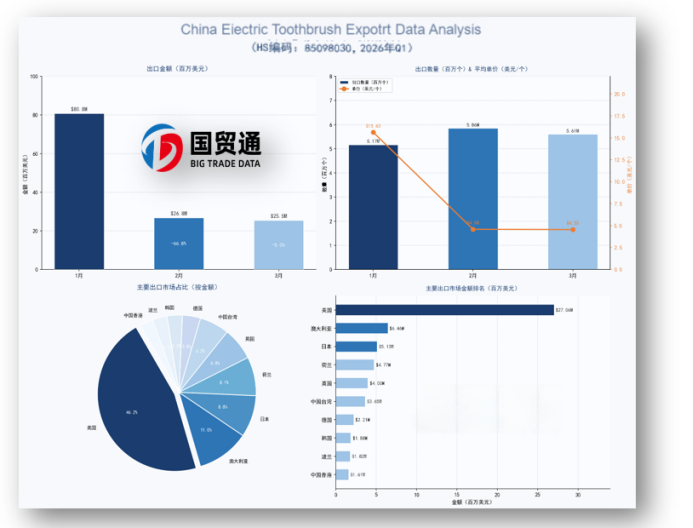
According to data from Big Trade Data, China's electric toothbrush export value in the first quarter of 2026 showed a high-to-low trend. In January, export value reached USD 80.84 million, the quarterly peak; in February, affected by the Chinese New Year holiday, export value dropped sharply to USD 26.83 million, a month-on-month decline of 66.8%; in March, export value was USD 25.49 million, a further month-on-month decrease of 5.0%, though the decline narrowed noticeably.
The data shows that January's export value accounted for 60.7% of China’s total electric toothbrush (HS: 85098030) exports in Q1, indicating concentrated early-year shipments. The steep month-on-month drop in February was mainly due to factory shutdowns during the holiday, while the narrower decline in March suggests a gradual recovery in exports.
In terms of export volume, the trend differed from that of value. Export volume actually grew month-on-month in February. Specifically: January exported 5.17 million units; February exported 5.86 million units, up 13.2% month-on-month; March exported 5.61 million units, down 4.3% month-on-month. This trend indicates a notable decline in unit prices during the February–March period.
Market Distribution
In Q1 2026, China's electric toothbrush (HS: 85098030) exports were primarily destined for developed countries and regions, with the United States, Australia, and Japan as the top markets. The U.S., as China's largest export market for electric toothbrushes, imported USD 27.06 million, accounting for 33.5% of total export value.
Although the U.S. market had the highest value share (≈33.5%), the unit price was only USD 2.89 per unit, indicating a predominance of mid-to-low-end products. Japan accounted for 6.3% of value—lower than Australia's share—but its average unit price reached USD 10.62, positioning it as a premium market. Within the EU, the Netherlands, the UK, Germany, and Poland together represented about 15.5% of total value, reflecting a diversified market landscape. Notably, the Taiwan market of China recorded an average unit price of USD 16.35, one of the highest among all destinations.
Competitive Advantages and Diversification
Export data shows that Chinese electric toothbrushes enjoy significant price competitiveness internationally. The overall average unit price ranges from approximately USD 4 to 15, catering to various tiers of international consumers. The U.S. market's heavy sourcing of mid-to-low-end products underscores China's strong cost competitiveness in this segment.
Furthermore, China's electric toothbrush exports cover multiple regions—North America, Europe, Asia-Pacific, Oceania, and beyond—demonstrating a high degree of market diversification. Such a diversified portfolio helps mitigate trade risks and reduce over-reliance on any single market. In particular, the penetration into European markets such as the Netherlands, the UK, Germany, and Poland indicates that Chinese electric toothbrushes are gradually entering more premium markets. Although emerging markets in Southeast Asia, the Middle East, and South America currently have low electric toothbrush penetration, their economic development and consumption upgrades present vast future opportunities.
Overall Outlook
Overall, the Q1 2026 export data for China's electric toothbrush (HS code: 85098030) confirms that China, as a major global manufacturer, maintains strong international competitiveness. Its export markets are highly diversified, and product offerings span low, mid, and high tiers, meeting the multi-level needs of global consumers.
Chinese manufacturers should increase R&D investment to develop high-end products with independent intellectual property rights, thereby raising value-added. At the same time, they should proactively obtain target-market product certifications (e.g., FDA, CE, RoHS) to remove market access barriers. Additionally, strengthening proprietary brand building—transitioning from OEM to ODM and OBM models—is crucial to fostering internationally recognized brands.
Establishing after-sales service networks overseas and providing localized support can enhance customer loyalty. Using eco-friendly materials and optimizing packaging designs will also align with the growing global demand for green products.
Looking ahead, as global oral care awareness rises and product technologies advance, China's electric toothbrush exports will encounter favorable development opportunities. However, companies must also stay alert to risks such as trade barriers, exchange rate fluctuations, and intensifying international competition. By reinforcing product R&D, completing certification systems, and building proprietary brands, they can enhance their global competitiveness and product value.
Risk Warnings
Trade Barrier Risks: Some countries may impose technical trade barriers or raise product access standards. Companies should complete relevant certifications (e.g., FDA, CE) in advance.
Exchange Rate Volatility Risks: Exporters face RMB exchange rate risks and are advised to utilize financial instruments for hedging.
Raw Material Price Volatility: Fluctuations in raw material prices (plastics, motors, etc.) will affect costs and competitiveness. Building a stable supply chain is essential.
Intensified International Competition: Traditional electric toothbrush manufacturing powerhouses such as South Korea and Germany are expanding their market presence, leading to fiercer competition.
Patent Infringement Risks: Some international markets have patent barriers. Exporters should conduct thorough intellectual property due diligence.
In summary, the export prospects for China's electric toothbrushes are broad, but the industry must accelerate its transformation from "manufacturing" to "innovation"to achieve high-quality development.
Big Trade Data, as China's first data company, provides customs data for over 90 countries from 2010 to the present. It enables online precision analysis of import/export market distribution, detailed transaction records of trading companies, quantitative and pricing analysis, supply cycle tracking, and more, offering reliable data support for foreign trade enterprises and industry consulting firms.