
Chemical staple fiber (HS Code: Chapter 55) is an important category of textile raw materials, widely used in apparel, home textiles, and industrial textiles. As the world's largest producer and exporter of chemical staple fiber, China ships its products to major textile production bases and consumer markets around the globe.
According to customs data, China's total export value of chemical staple fiber (HS: Chapter 55) for the full year of 2025 reached USD 14.124 billion, a slight decrease of 0.6% compared to the previous year. In the first quarter of 2026, total export value reached USD 3.513 billion, representing a year-on-year increase of 0.74% from the same period in 2025.
In 2025, China's total export value of chemical staple fiber to its top ten destination countries reached USD 7.179 billion, with markets primarily distributed across Southeast Asia, South Asia, South America, and Eastern Europe. Against the backdrop of uneven global economic recovery and restructuring trade patterns, market performances varied significantly: five countries achieved year-on-year growth, while five experienced declines. This divergent pattern reflects the latest development trends in the global textile industry chain.
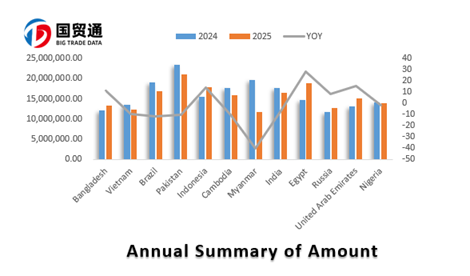
Southeast Asia remains China's most important export destination for chemical staple fiber. Vietnam (USD 1.524 billion) and Bangladesh (USD 1.562 billion) jointly ranked as the top two destinations, together accounting for approximately 42% of the total value of the top ten markets, fully demonstrating the region's core position as a global textile production hub. However, both major markets saw year-on-year declines: Vietnam fell by 8.95%, primarily due to the diversion of some textile orders to lower-cost regions during 2024-2025, coupled with domestic inventory digestion pressures that suppressed import demand. Bangladesh saw a modest decline of only 0.22%, maintaining overall stability and highlighting the strong resilience of its garment industry. In contrast, emerging Southeast Asian textile countries such as Cambodia (+9.11%) and Myanmar (+16.44%) showed outstanding growth, reflecting that China's staple fiber exports are accelerating their penetration into emerging production bases with stronger cost competitiveness within the region, with clear characteristics of intra-regional industrial gradient transfer.
The South Asian market performed strongly, emerging as the most dynamic growth pole in 2025. India recorded the highest growth rate of 24.06%, with import value reaching USD 416 million, reflecting both the strong demand for chemical fiber raw materials driven by India's rapidly expanding textile production capacity and the stimulating effect of its absorption of some relocated orders.
Pakistan's import value reached USD 653 million, with a robust year-on-year increase of 22.51%. This growth reflects both the gradual recovery of its domestic textile industry after the difficulties of 2023-2024 and the significant rebound in raw material import demand driven by government export incentive policies.
Indonesia ranked fifth in import volume, with a steady year-on-year increase of 2.41%, reflecting the rigid demand for basic raw material imports from large textile-producing countries.
Brazil, as China's largest export market for chemical staple fiber in Latin America, reached an export value of USD 684 million in 2025, ranking third, but experienced a year-on-year decline of 5.09%. This decline is mainly attributable to three factors: first, the continued depreciation of the Brazilian real has raised import costs; second, overall weak domestic textile consumption and high inventory levels have suppressed corporate purchasing intentions; and third, some Brazilian textile companies have increased procurement from domestic and neighboring markets, leading to a contraction in demand for Chinese products. The potential of the Latin American market remains worth anticipating, but in the short term it is highly price-sensitive, requiring ongoing attention to exchange rate and macroeconomic trends.
The strategic value of African and Middle Eastern markets warrants further exploration. Taking Egypt as an example, in 2025, the country's imports of Chinese chemical staple fiber reached USD 413 million, a year-on-year decline of 8.31%, making it one of the most significant declining markets among China's major African export destinations. Foreign currency shortages, tightened import controls, and capacity adjustments by local textile enterprises are the main reasons for this decline. The long-term development potential of Africa's textile industry should not be overlooked. With the continued advancement of the African Continental Free Trade Area (AfCFTA), regional trade activity is expected to increase, which will further drive demand for textile raw materials.
Russia, which continues to be affected by geopolitical factors, recorded the most significant decline. In 2025, the country's imports of Chinese chemical staple fiber reached USD 388 million, a substantial year-on-year decrease of 30.86%, the largest decline among China's top ten export markets for chemical staple fiber, making it the risk market requiring the most attention.
The core reasons for Russia's import decline include: first, ongoing geopolitical conflicts have had a profound impact on its textile industry chain, leading to a contraction in market demand; second, Western sanctions have hindered international trade financing and logistics channels; and third, fluctuations in the ruble exchange rate have increased import costs. This trend warrants high vigilance from export enterprises, and it is recommended to reasonably manage exposure to the Russian market.
Overall, the future of China's chemical staple fiber industry presents both opportunities and challenges. On the one hand, the substantial growth in raw material demand driven by South Asian markets' absorption of industrial chain transfers will continue to create incremental export opportunities for China. Emerging ASEAN markets are expanding rapidly with significant growth potential. Moreover, with the deepening implementation of RCEP, tariff reduction effects will further enhance the competitiveness of Chinese products.
On the other hand, enterprises also need to pay attention to core risks in export markets: exchange rate fluctuations, geopolitical uncertainties, reduced import dependence due to increased local production capacity in some markets, and the pressure of cost transmission from fluctuations in international commodity prices.
Chinese manufacturers should seize the high-growth opportunities in India and Pakistan, establish stable local cooperation channels to increase market share, while strengthening their presence in high-growth markets such as Cambodia and Myanmar, actively keeping pace with local textile industry development trends. Additionally, attention should be paid to exchange rate risks in the Latin American market, and product differentiation upgrades should be promoted.
The 2025 export market for China's chemical staple fiber overall exhibited characteristics of "stable but with changes, and increasing divergence." The continued vitality of South Asian markets represented by India and Pakistan, coupled with the rapid growth of emerging Southeast Asian markets represented by Cambodia and Myanmar, have injected new growth momentum into China's staple fiber exports. At the same time, markets such as Russia and Egypt, affected by multiple factors, have become noteworthy risk points. Facing a complex and volatile global trade environment, Chinese chemical staple fiber enterprises should deepen market diversification strategies, accelerate product structure upgrades, and leverage the institutional dividends of regional cooperation mechanisms such as RCEP to continuously enhance their core position and competitive advantage in the global textile supply chain.
As the first data company in China, Big Trade Data provides import and export customs data for over 90 countries from 2010 to the present, enabling online precision analysis of import and export market distribution, detailed transaction information of import and export enterprises, specific volume-price analysis, supply cycles, and more. We provide reliable data-driven insights for foreign trade enterprises and industry consulting firms.
(This article is an original piece by Big Trade Data. Please indicate the source when reprinting.)